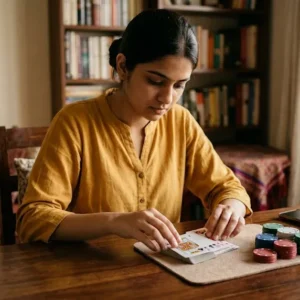


If you’ve ever sat down for a round of Teen Patti at a family gathering during Diwali or opened an online table on a popular Indian platform, you’ve probably heard words flying around that sound familiar yet confusing. Boot, chaal, trail, pack — these teen patti casino terms form the everyday language of the game. Understanding them turns a confusing table into a clear, enjoyable one.
Teen Patti (literally “three cards”) is India’s beloved three-card game, played with a standard 52-card deck by three to six (sometimes up to seven) players. The goal is simple: hold the strongest hand or force everyone else to fold. But the language around it has its own flavour, mixing Hindi roots with casino-style English. Here’s a clear, practical breakdown of the essential teen patti casino terms you’ll hear in both home games and online casinos popular with Indian players.
Hand Ranking Terms – What Beats What
These six hands decide the winner when cards are finally shown. Ranked from strongest to weakest:
- Trail (also called Trio, Set, or Three of a Kind)
Three cards of the same rank. Aces are the highest (A-A-A), twos the lowest. This is the strongest possible hand. - Pure Sequence (also called Straight Flush or Pure Run)
Three consecutive cards of the same suit. A-K-Q of hearts or A-2-3 of the same suit are top examples. Note that 2-A-K is not valid in most versions. - Sequence (also called Run, Straight, or Normal Run)
Three consecutive cards of mixed suits. Same ranking order as pure sequences, but weaker because the suits don’t match. - Colour (also called Color or Flush)
Three non-sequential cards of the same suit. The highest card decides ties. - Pair (also called Double)
One unconnected card and two cards of the same rank. Higher pairs beat lower ones; the third card acts as a kicker if pairs match. - High Card (also known as Nothing or No Pair)
No combination at all. The cards are ranked from highest to lowest.
Memorising this order is the fastest way to stop second-guessing during a show.
Core Betting and Action Terms

These are the words you’ll hear most often while the pot is building.
- Boot (or Ante)
Before cards are given, each player contributes a set sum to the pot. It creates the starting pot and is agreed upon at the beginning of the game. - Blind
Playing without looking at your three cards. Blind players usually bet smaller amounts (often 1× the current stake, up to 2×). Many Indian players start blind for a few rounds to keep the action moving and hide information. - Seen
Looking at your cards before betting. Seen players must bet more (commonly 2× the current stake, up to 4×). Once you see your cards, you stay “seen” for the rest of the hand. - Chaal
Before cards are given, each player contributes a set sum to the pot. In everyday Indian table talk, “putting chaal” simply means matching or raising the current stake after seeing (or while playing blind). - Pack (or Fold)
Dropping out of the current hand and forfeiting any money already put in. “Pack kar diya” is one of the most common phrases you’ll hear. - Raise
Increasing the current stake. Limits are often determined by the house rules of the table or online platform, as well as whether you are seen or blind. - Show
Either player may ask for a show when there are just two left. The stronger hand wins the pot after both expose their cards. The player asking for the show usually pays a set amount (often equal to the current stake or twice it, depending on rules). - Sideshow (also called Compromise)
While other players are still active, two players are privately compared. The loser of the sideshow packs. Not every table allows it, and the previous player can refuse. - Pot
The total money collected in the middle of the table. The pot contains everything that has been wagered thus far. - Current Stake
The amount the last player put in. The next player’s minimum and maximum bets are calculated from this figure.
Other Useful Teen Patti Casino Terms
- Dealer – The person (or automated system online) who shuffles and deals three face-down cards to each player. The dealer position usually rotates clockwise.
- Pot Limit – A common rule on many online tables where no single bet can exceed the current size of the pot.
- Muflis (or Lowball) – A popular variation where the lowest-ranking hand wins instead of the highest.
- Hukam – In some joker or wild-card versions, this refers to the wild card.
- Post – Paying a missed boot when you rejoin a table after stepping away.
Why These Teen Patti Casino Terms Matter for Indian Players
In India, Teen Patti is more than a game — it’s part of festivals, family nights, and late-evening online sessions. Knowing the proper terms helps you:
- Follow the action without asking “matlab kya hai?” every few minutes
- Play confidently on both local apps and international platforms that offer Teen Patti
- Avoid simple mistakes like confusing a sequence with a pure sequence or misjudging how much a seen player must put in
Whether you play for fun with relatives or real-money tables, clear language keeps the game fair and enjoyable.
Quick Tips to Remember the Terms Faster

- Group them: hand rankings in one mental list, betting actions in another.
- Practise saying the Hindi-rooted words out loud — chaal, pack, boot — they stick better that way.
- Watch one full hand online with the sound on; the commentary or table chat will reinforce the terms in real time.
Mastering these teen patti casino terms takes only a short while, but it changes how the whole game feels. Next time someone says “main blind chaal daal raha hoon” or “sideshow maangta hoon,” you’ll know exactly what’s happening and what to do next. Enjoy the cards, play responsibly, and may your trails come often.