

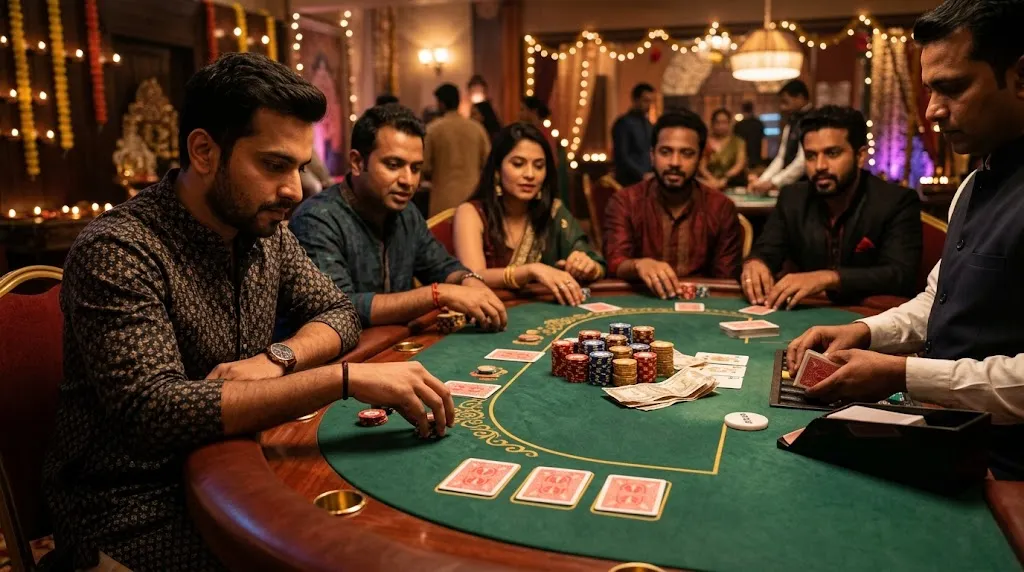
 Teen Patti remains one of the most loved card games across India, whether it’s a late-night session with friends, a festive Diwali gathering, or a digital table at an online casino. Understanding teen patti casino gameplay properly makes every hand clearer and more enjoyable. Here’s a fresh, straightforward walkthrough of exactly how a typical round unfolds.
Setting Up the Table
Most rounds begin with 3 to 6 or 7 players using a standard 52-card deck (no jokers). Before any cards are dealt, everyone agrees on the boot (also called the ante or minimum stake). The predetermined sum is dropped into the center pot by each player. This creates the starting prize that everyone is chasing.
A dealer is chosen (often by drawing the highest card or simply rotating clockwise each round). The dealer then gives three cards face-down to every player, one at a time, moving clockwise. No one sees anyone else’s cards.
The First Big Decision: Blind or Seen
This is the heart of teen patti casino gameplay. On your turn (starting with the player to the dealer’s left), you choose:
- Play Blind — You wager without looking while keeping your cards face down. Blind bets are smaller: usually equal to the current stake (or up to twice that amount).
- Play Seen (or Chaal) — You look at your three cards. Once you have seen them, you become a “seen” player and must bet at least double the current stake of a blind player.
You can start blind and decide to look later. Once you look, however, you stay seen for the rest of the hand. It is impossible to return to blindness.
Betting Continues Clockwise
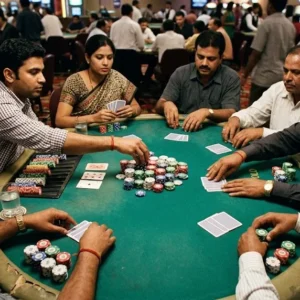
Play moves around the table. Every turn, a player has to either:
- Match the current required bet (call/chaal)
- Raise within the allowed limits
- Fold (pack) and leave the hand
Seen players always pay a higher minimum than blind players. This rule keeps the game balanced — information costs more money. The pot grows quickly when players keep raising. Betting continues until only one player remains (who wins the pot without showing cards) or until just two players are left.
Side Show and Final Show
When more than two players are still in, a seen player can sometimes request a side show from the previous seen player. Both privately compare hands; the weaker one is forced out. Blind players usually cannot request or accept side shows.
Either player may request a show when there are just two left. Both reveal their cards, and the stronger hand takes the entire pot. In many versions, if the hands are identical, the player who asked for the show loses. If everyone else has folded earlier, the last remaining player simply collects the pot — no need to show anything.
Hand Rankings (Highest to Lowest)
These rankings decide the winner in a showdown:
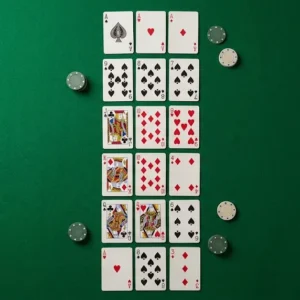
- Trail / Trio — Three of a kind (A-A-A is strongest)
- Pure Sequence — Three consecutive cards of the same suit (straight flush)
- Sequence — Three consecutive cards of mixed suits
- Colour — Three identical suit cards (not in order)
- Pair — Two identically ranked cards
- High Card — Highest single card wins when nothing else matches
Note that some Indian tables treat A-2-3 as the highest pure sequence, while others rank A-K-Q highest. Always check the specific table rules.
Why This Flow Feels So Indian
The blind-versus-seen choice, the side-show option, and the fast-moving pot create a unique rhythm that players across Maharashtra, Punjab, Delhi, and the rest of India recognise instantly. Online casinos and apps have kept the same core structure while adding timers, auto-deal, and clear stake displays so the classic teen patti casino gameplay stays intact on mobile.
A typical round rarely lasts more than a few minutes once everyone knows the flow. The real skill lies in reading when to stay blind for pressure, when to look and raise, and when to fold early. Once you internalise these steps, every new table feels familiar.
That is how a standard round of Teen Patti works — from the first boot to the final show.