

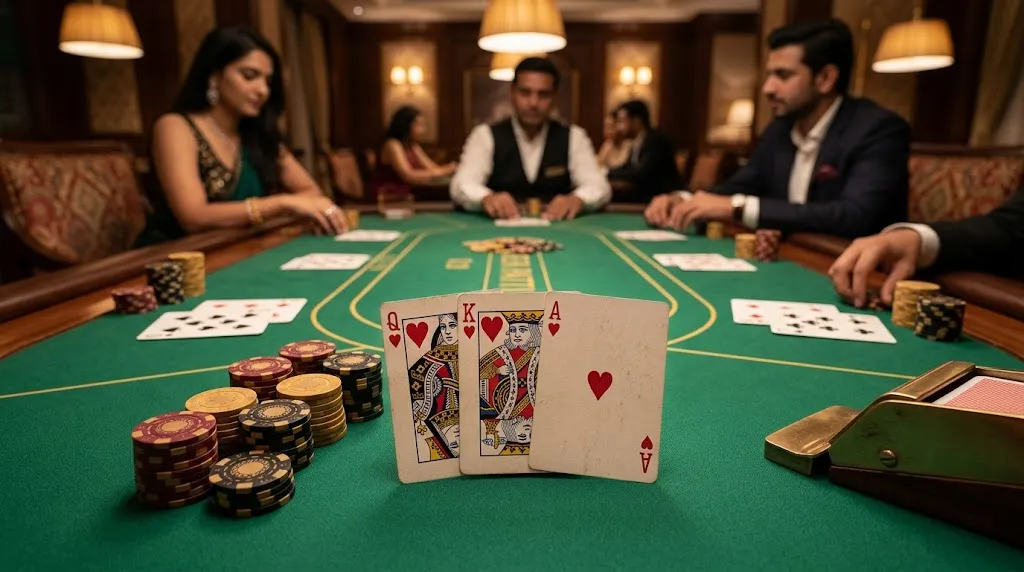
If you play Teen Patti in India—whether with friends during Diwali, on popular apps, or at online casinos—you already know the game feels equal parts skill and luck. The real edge comes when you stop guessing and start understanding the actual teen patti casino probability behind every hand. Once you know how rare (or common) each hand really is, your decisions become sharper, your bluffs more calculated, and your bankroll lasts longer.
Let’s break it down in plain language, with the exact numbers that matter for Indian players.
The Numbers Behind Every Deal
A standard 52-card deck gives exactly 22,100 possible three-card hands. That’s the total universe every time the cards are dealt. Here’s how those hands actually break down:
Rank | Hand | Combinations | Probability | Rough Odds |
1 | Trail (Three of a Kind) | 52 | 0.24% | 1 in 425 |
2 | Pure Sequence (Straight Flush) | 48 | 0.22% | 1 in 460 |
3 | Sequence (Straight) | 720 | 3.26% | 1 in 31 |
4 | Colour (Flush) | 1,096 | 4.96% | 1 in 20 |
5 | Pair | 3,744 | 16.94% | 1 in 6 |
6 | High Card | 16,440 | 74.39% | 3 in 4 |
These figures are fixed. Whether you’re playing in Mumbai, Delhi, Bangalore, or on any major Indian online platform, the math stays the same.
What These Probabilities Mean in Real Play
High Card rules most of the time.
Three out of every four hands you receive will be a High Card. That’s why experienced Indian players rarely go all-in on weak high cards unless the table dynamics scream “everyone is weak.”
Pairs are your everyday bread-and-butter.
You’ll see a pair roughly once every six hands. A pair of Aces or Kings is strong enough to play aggressively in most situations, especially if you’re the only one raising.
Colour and Sequence are solid but not rare.
A Colour (three cards of the same suit) shows up about once every 20 hands. A normal Sequence appears once every 31 hands. Both beat a pair, so when you hold either, you can start thinking about building the pot—especially if opponents are calling light.
Trail and Pure Sequence are genuine rarities.
A Trail lands only once in roughly 425 hands. A Pure Sequence is even scarcer—about once in 460 hands. Many players go entire long sessions without seeing either. When you finally get one, the correct move is almost always to extract maximum value rather than slow-play forever.
Interestingly, Pure Sequence is slightly rarer than Trail, yet Trail ranks higher by long-standing Indian convention. That’s just how the game is played across most home games and apps in India.
Why Hand Strength Knowledge Wins More Money
Understanding teen patti casino probability changes how you play in practical ways:
- You stop overvaluing mediocre high cards.
- You recognise when a pair is likely the best hand at the table.
- You size your bets better when you hold Colour or Sequence.
- You treat Trail and Pure Sequence as the premium hands they are—without getting carried away by the excitement.
In Indian online rooms and casino tables, many players still play purely by feel. When you play by the actual odds, you gain a quiet but consistent edge.
A Quick Reality Check for Indian Players
In a typical 100-hand session online, the average distribution looks something like this:
- ~74 High Cards
- ~17 Pairs
- ~5 Colours
- ~3 Sequences
- 0 or 1 Trail / Pure Sequence (most of the time zero)
This is why bankroll management matters more than waiting for monster hands. The strong hands come rarely. Smart players make their money by correctly evaluating the medium-strength hands that appear far more often.
Final Thought

Teen Patti remains one of India’s favourite card games because it mixes tradition, psychology, and simple probability. Knowing the real teen patti casino probability of each hand strength doesn’t remove the thrill—it actually makes the game more enjoyable. You stop relying on gut feeling alone and start making decisions backed by numbers that never change.
Next time the cards are dealt, you’ll look at your hand differently. That small shift is often the difference between finishing the night ahead or wondering where the money went.