

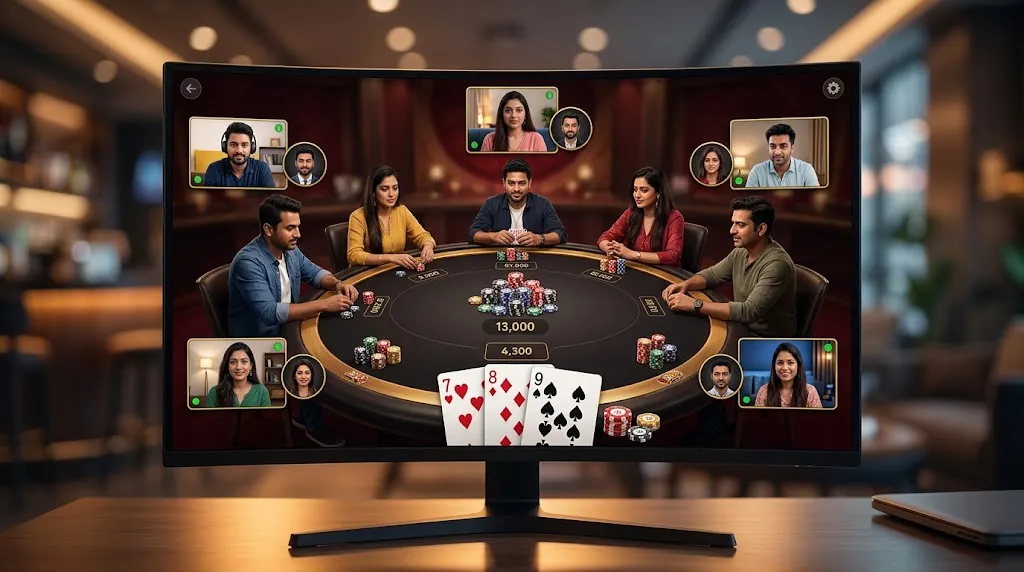
If you have ever sat around a Diwali table with relatives, you already know the rhythm of Teen Patti. Three cards slide across the table, someone says “blind,” someone else raises, and the whole room leans in. That same energy now lives in Teen Patti casino multiplayer rooms, where up to seven real players from across India sit at virtual tables with live audio, private invites, and stakes that start as low as ₹2.
But playing multiplayer Teen Patti is not the same as playing alone against a screen. At a real table — physical or digital — every decision you make is visible to other people, and every bet tells a story. This guide walks through exactly how table play works: the boot, the blind-versus-seen cycle, side-shows, showdowns, and the table manners that mark you as someone who actually knows the game.
The Table Is the Game
In a teen patti casino multiplayer setup, the table itself shapes everything. A seven-seat table plays very differently from a three-seat one. With more players, moderate hands like pairs become more valuable because the odds of someone holding a trail or pure sequence drop. With fewer players, aggression gets rewarded, and blind play becomes a sharper weapon.
Online platforms now support tables with 2 to 7 real players, live voice chat, and private rooms you can create and invite friends into. Some apps also offer multilingual support — English, Hindi, Gujarati, Telugu — so a table in Mumbai feels the same as one in Hyderabad.
Before any cards are dealt, every player at the table posts a boot — a small forced bet that seeds the pot. On digital platforms, the boot and betting limits are fixed per table and displayed before you sit down. In home games, boots typically range from ₹2 to ₹500, and regulars often cap the total pot at twenty boots — so a ₹5 boot table has a ₹100 ceiling, while a ₹50 boot table caps at ₹1,000.
Blind, Seen, and the Chaal Cycle
Once the boot is collected, three cards go face down to each seat. The betting begins, and this is where multiplayer Teen Patti separates itself from passive card games.
When you wager blindly, you don’t look at your cards. The advantage is cost: a blind player only needs to match the current stake, not double it. The disadvantage is information — you are guessing while seen players are calculating. Blind play works best in the early rounds, when the stakes are low and you can apply cheap pressure while gathering betting-pattern intel from opponents.
Seen play — also called chaal — means you have looked at your cards and are betting on their strength. A seen player must bet at least double the current stake, and often four times, depending on table rules. This cost difference is the core tension of the game: blind players pay less but know less; seen players pay more but can make informed decisions.
The betting continues clockwise. On each turn, a player can fold, match the stake, or raise. When there are just two players left or when all but one have folded, the round is over. The last showdown can be called by either of the two remaining players.
Side-Shows: The Quiet Move That Changes Everything
A side-show is a private comparison between two seen players. It is only asked if there are still at least three players in the pot after you have placed the minimum wager. The player acting after another seen player can ask the previously seen player for a side-show. If accepted, the two players privately compare hands, and the weaker hand folds immediately.
This move adds a layer of strategy that few beginners understand. A side-show lets you eliminate a specific opponent without exposing your hand to the whole table. But if your opponent refuses, you have learned something too — they are either very strong or very cautious, and both pieces of information are useful.
Blind players cannot request a side-show. The rule exists for seen players only, because it depends on both parties having information to compare.
What Beats What: A Quick Ranking Refresher
You cannot play a multiplayer table without knowing the hand order cold. From highest to lowest:
- Trail (Trio) — three cards of the same rank, like A♥ A♠ A♣.
- Pure Sequence — three consecutive cards of the same suit, like 9♥ 10♥ J♥.
- Sequence (Run) — three consecutive cards of mixed suits.
- Colour (Flush) — Three identical-suited cards, not in order
- Pair — The same rank plus a kicker rank plus a kicker.
- High Card — none of the above.
The ranking is set by rarity, not intuition. Pure sequences are harder to be dealt than ordinary colours, which is why they sit higher. At a full seven-seat table, you will see a trail roughly once every 425 rounds, so treat the sight of one as a genuine event.
Table Etiquette That Marks a Real Player
Multiplayer Teen Patti has unwritten rules that separate a smooth table from a messy one. These matter just as much online as they do at a physical baazi.
Post the boot without delay. At a real table, fumbling with chips breaks the rhythm. Online, the boot is automatic, but you still need to be ready to act when your turn comes.
Do not demand a show from a blind player. If you are seen and your opponent is blind, you cannot force a showdown. The only options are to fold or continue betting. This is one of the most common beginner mistakes, and it slows the table down for everyone.
Announce your side-show clearly. A side-show is a private agreement, not a table-wide event. If you request one, do it quietly. If you accept one, compare and resolve without theatrics.
Watch the table, not just your cards. In multiplayer Teen Patti, observation is the most underappreciated ability. Note who raises rapidly, who packs early, and who bluffs often. This information is more valuable than any one hand at a seven-seat table.
Practical Tips for Indian Tables
Set a bankroll before you sit down. Prior to the first trade, determine the greatest amount of money you are willing to lose, and stop when you reach it, win or lose. This is the single biggest discipline that separates steady players from frustrated ones.
Start with small boots to learn the table. If you are new to multiplayer, sit at a ₹2-boot table first. The stakes are low enough that you can experiment with blind pressure and side-show timing without risking a significant amount.
Check your state’s law before real-cash play. Teen Patti for real money is restricted or banned in several Indian states. Where real-money play exists, treat it as entertainment and verify local regulations before participating.
Use private tables for practice. Most multiplayer platforms let you create private tables and invite friends. This is the best way to learn table dynamics — the betting rhythms, the side-show etiquette, the blind-versus-seen balance — without the pressure of a public room.
The Bottom Line
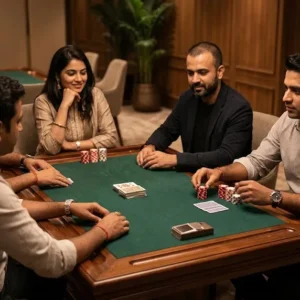
Teen Patti casino multiplayer is not just Teen Patti with more people. It is a different game — one where the table itself is a character, where blind play is a lever, where a side-show can quietly end someone’s night, and where it is just as important to read the room as it is to read your cards. Master the boot, respect the blind-seen balance, use side-shows with precision, and you will sit down at any Indian table — physical or digital — like you belong there.