

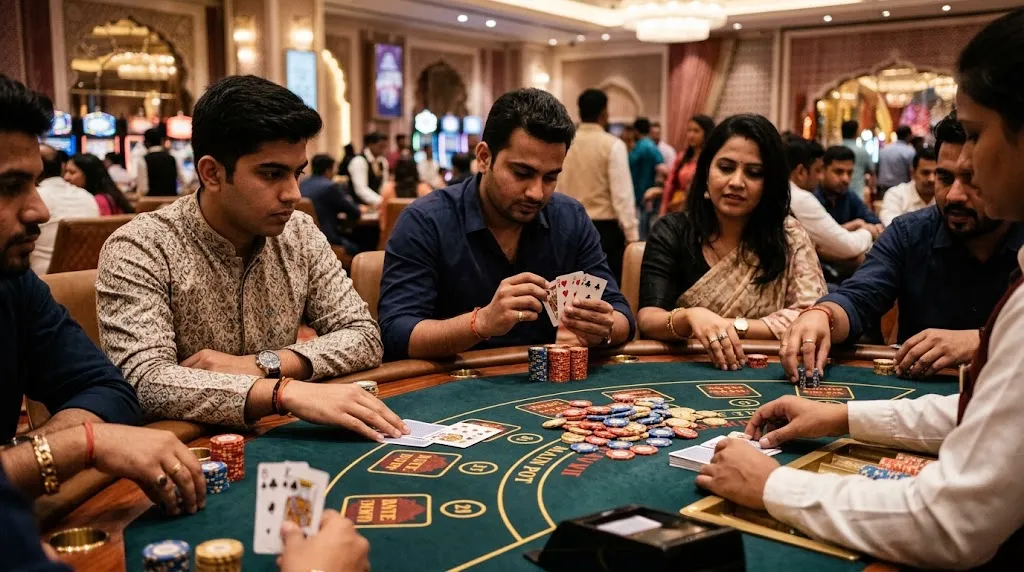
 If you play Teen Patti online or offline in India, the choice between Blind and Seen is one of the first real decisions you make every hand. It shapes how much you risk, how much information you have, and how opponents read you. Understanding teen patti casino blind vs seen is essential for better bankroll control and sharper decisions at Indian tables.
What Blind and Seen Actually Mean
In Teen Patti, every player receives three cards face down after the boot (ante) goes into the pot.
- Blind means you deliberately keep your cards face down and bet without looking. You play purely on position, table dynamics, and instinct.
- Seen means you look at your three cards first, then decide whether to continue, raise, or pack (fold).
You can start Blind and switch to Seen later on your turn by looking at the cards. Once you look, you stay Seen for the rest of that hand. You cannot go back to Blind.
This mechanic is a core feature of Teen Patti played across India — whether at home gatherings in Delhi, Mumbai clubs, or popular online platforms popular with players from Bangalore, Hyderabad, and beyond.
Betting Amounts: The Biggest Practical Difference
Betting rules differ clearly between Blind and Seen players. Exact numbers can vary slightly by house or platform rules, but the standard structure used in most Indian Teen Patti games is:
Aspect | Blind Player | Seen Player |
Minimum bet | Equal to current stake (1x) | Double the current stake (2x) |
Maximum bet / raise | Up to 2x current stake | Up to 4x current stake |
Effect on next stake | Your full bet becomes the new stake | Half of your bet usually becomes the new stake for the next player |
Cost advantage | Lower risk per round | Higher commitment required |
In simple terms, a Blind player can stay in cheaper. A Seen player pays roughly double to continue with full information. This cost difference is why many experienced Indian players open Blind more often in the early stages of a hand.
Show and Sideshow Rules
These also change based on status:
- Blind players generally cannot request a sideshow.
- Only Seen players can ask for a sideshow against another Seen player (when three or more players remain). The opponent can accept or refuse.
- When only two players remain, either can force a show. The cost is usually lower for a Blind player (often 1x the current stake) than for a Seen player (commonly 2x, or higher if facing a Blind opponent).
These rules add another layer of strategy unique to Teen Patti.
Strategic Differences for Indian Players
Playing Blind
- Keeps opponents guessing — they cannot read your reaction to the cards.
- Lowers the average amount you put into the pot.
- Useful early in a hand or when you want to apply pressure cheaply.
- Higher risk because you have zero information about hand strength.
Playing Seen
- Lets you make informed decisions based on actual hand rankings (Trail, Pure Sequence, Sequence, Colour, Pair, High Card).
- Allows sideshows and more precise pot control.
- Costs more every time you continue.
- Best when you hold a strong or playable hand and want to build or protect the pot.
Strong players in Indian online rooms often mix both approaches. Starting Blind to keep costs low, then switching to Seen only when the cards (or the pot size) justify the extra investment, is a common and effective pattern.
Why This Matters for Indian Online and Local Play
Teen Patti remains one of the most popular card games in India, both casually and on digital platforms. The Blind vs Seen decision is the same whether you are playing a friendly game in a Kolkata living room or on a regulated online table accessible from major cities. Knowing the exact cost difference and show rules helps you manage your stack better and avoid over-committing with weak hands.
Local house rules in different states or friend groups sometimes tweak the multipliers slightly, so always confirm the table rules before the first deal. Online platforms usually display the current stake and your status (Blind/Seen) clearly on screen.
Quick Tips to Use Blind and Seen Effectively
- Open Blind more often when the table is passive or when you want to keep your average cost per hand low.
- Switch to Seen quickly with strong holdings so you can raise meaningfully and request sideshows if needed.
- Watch how often opponents stay Blind — consistent Blind play can signal either tight cost control or aggressive bluffing.
- Never forget you can only move Blind → Seen, never the other way.
The Blind vs Seen choice is what makes Teen Patti feel distinctly Indian and different from pure Western poker variants. Mastering when to stay in the dark and when to look is one of the clearest ways to improve your results over time.
Whether you play casually with friends or on online Teen Patti tables popular across India, understanding these key differences gives you a real edge in every hand.